


General FAQs
Kebony is a highly durable, sustainable wood with the aesthetics and performance of the best tropical hardwood. It requires minimal maintenance with low life cycle costs.
Kebony technology is a combination of the infusion of a bio-based liquid and exposure to heat in the excess of 100°C, which permanently thickens up the cell wall of the wood. Heat-treated timber processes are purely high temperature treatments (170°C – 215°C), which does not alter the cell structure of the timber, but stiffens and makes the cell walls more brittle.
Kebony wood can be handled as ordinary wood. It can be recycled, repurposed, or burnt.
Kebony can be used both indoors and outdoors in applications which include decking, cladding, flooring, roofing, windows, doors, furniture and design objects
Kebony is much easier to work with than tropical hardwoods. Carbide tools should still be used but will last much longer.
Kebony offers a 30-year warranty against rot for above ground contact use.
See the Where to Buy section on our website or submit an online quote request.
You can request a free sample online, send your inquiry to [email protected] or contact your nearest retailer.
You can submit an online quote request, send your purchase order to [email protected] or contact your nearest retailer.
The Kebony process substantially improves the wood’s dimensional stability, typically by 50% compared to the original wood species. For example, Kebony Clear will swell tangentially by only 4% – better than almost all other woods.
The bending strength of Kebony is roughly unchanged from the parent wood, while the stiffness is improved by 10-20%. The hardness is typically improved by 30-50% over the parent wood. Complete specifications can be found in the relevant product information sheet.
Kebony is a natural product. Our process alters the wood fibers’ ability to hold moisture as a result of cell modification. Kebony has lower moisture content than untreated wood when it is in equilibrium with its surrounding climate. This effect is caused by the formation of the polymer inside the wood fibers. The process also reduces the shrinking and swelling of Kebony compared to the parent wood by 50%. The dimensional stability at moisture variations is therefore vastly improved.
Kebony wood does not require any special maintenance beyond normal cleaning.
Kebony is produced from FSC®-certified woods.
Kebony is about as hard as hard Maple. Consequently, Kebony should be machined at slower feed rates using carbide-tipped knives.
Kebony has a substantially lower carbon footprint than most tropical hardwoods. More details on the comparison of Kebony with Ipé can be found on the following infographic.
Kebony wood is delivered in a dark brown color as a result of the Kebony technology. The shade of brown does vary slightly depending on the wood species. If left exposed to the elements, all Kebony woods will develop a silver patina over time.
We recently launched a few color variations.
Technical FAQs
Kebony Clear can be both ripped and crosscut. We recommend using high quality carbide blades that are suitable for tropical hardwoods.
Kebony Character can only be crosscut and should not be ripped as it will expose untreated heartwood. We recommend using high quality carbide blades that are suitable for tropical hardwoods.
End-sealing is not mandatory for Kebony Clear, but in order to limit variations in moisture in the end grain, a water-repellent end grain sealer will reduce the potential for splitting.
Kebony Character crosscuts must be sealed using an anti-parasite/fungal agent. Follow the manufacturer’s instructions.
The SRI values under Low, Medium, and High intensity are respectively, 49.1, 49.3, and 49.4
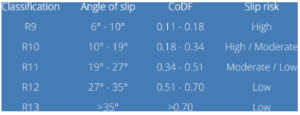
There is no one recognized standard test for slip resistance. Kebony has performed several different tests in an effort to illustrate performance in different conditions.
DIN 51097
DIN 51097 ramp testing is a pedestrian slip test method utilizing soapy water and bare feet.
The outcome of this test was a rating of Group A.

DIN 51130
DIN 51130 ramp testing is a pedestrian slip test method utilizing motor oil and cleated safety boots.
The outcome of this test was an R11.
Fastener Location
Kebony Clear requires predrilling. Position the screws at least 20 mm from the side of the board and at least 25 mm from its end. Do not screw the screw in too deeply; the top of the screwhead should be flush with the surface of the board.
Fastenings in contact with the timber must be made from acid-proof (A4) or stainless (A2) steel. A4 is generally recommended and must always be used in coastal areas and chloride environments; A2 must only be used is less corrosive environments. Screws of a different quality or use of A2 in the wrong environment may result in dark discolouration around the screwholes.
The density of Kebony Clear is approximately 41.8 lb/ft3 or 670 kg/m3.
Kebony Clear’s Janka hardness is 1619 lbf.
You can see the complete warranty here.
Water and a brush with only garden hose pressure. Do not use a pressure washer.
Outdoor furniture
Bio‑infused wood like Dually Modified Kebony is engineered to perform exceptionally well outdoors. The modification process improves the wood at a cellular level, making it highly stable, rot‑ and pest‑resistant, and far more durable than untreated wood. It absorbs significantly less moisture, reducing warping and cracking, and can last 50+ years outdoors. The process is 100% non‑toxic, requires minimal maintenance, and delivers a rich, uniform appearance that weathers beautifully over time.
- Exceptional stability: Dually Modified wood absorbs 70% less moisture than untreated wood, greatly reducing warping, swelling, and cracking in changing weather.
- Naturally rot‑ and pest‑resistant: The modification process removes or neutralizes the sugars that attract insects, fungi, and mold—without added chemicals.
- Long outdoor lifespan: Properly modified wood can last 25–40 years outdoors, comparable to premium hardwoods like teak.
- 100% non‑toxic: Bio‑based modification uses natural infusion methods, making it safe for children, pets, and food contact.
- Low maintenance: No frequent sanding, sealing, or chemical treatments required—simple periodic cleaning is enough.
- Premium appearance: The process creates a rich, uniform brown tone that can be maintained with oil or left to weather evenly into an elegant silvery‑gray patina.